
Please use this identifier to cite or link to this item:
http://hdl.handle.net/10267/1472| Title: | POLS 200-01, Urban Politics, Spring 2008 |
| Authors: | Goldberg, Arielle C. |
| Keywords: | Political Science, Department of;Syllabus;Curriculum;Academic departments;Text;2008 Spring |
| Issue Date: | 1-Apr-2008 |
| Publisher: | Memphis, Tenn. : Rhodes College |
| Series/Report no.: | Syllabi CRN 28477 |
| Abstract: | This course poses the normative questions: ��Who should make decisions about urban politics?��; ��To what extent should the public be involved in setting the agenda for urban decision making?�� and; ��What responsibilities and goals should urban governments take on?�� We also consider how larger political and economic forces shape the parameters of urban politics. The course is divided into four sections that shed light on these questions. The first section of the course is designed to give students a foundation in the evolution of cities including their role in the federal system. The second section examines the institutional arrangements that shape decision-making in U.S. cities and Memphis, in particular. In the third section, we consider the competing theoretical models that explain how decision making actually works in U.S. cities. The final section of the course analyzes Memphis politics, particularly the politics of race and reform, through the lens of the campaigns and elections of Memphis Mayor W.W. Herenton. The goal is to understand how political alliances, ��ideas,�� institutional arrangements and larger historical forces facilitate and constrain decision making in the 20th and 21st centuries. |
| Description: | This syllabus was submitted to the Rhodes College Office of Academic Affairs by the course instructor. |
| URI: | http://hdl.handle.net/10267/1472 |
| Appears in Collections: | Course Syllabi |
Files in This Item:
| File | Description | Size | Format | |
|---|---|---|---|---|
| 2008_sp_POLS_200-01_28477.pdf | 34.24 kB | Adobe PDF | 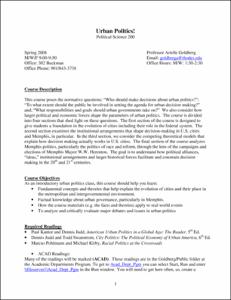 View/Open |
Items in DSpace are protected by copyright, with all rights reserved, unless otherwise indicated.