
Please use this identifier to cite or link to this item:
http://hdl.handle.net/10267/3592| Title: | PSYC 150-02, Foundational Issues in Psychology, Fall 2007 |
| Authors: | Russell, Kathy |
| Keywords: | Psychology, Department of;Syllabus;Curriculum;Academic departments;Text;2007 Fall |
| Issue Date: | 23-Aug-2007 |
| Publisher: | Memphis, Tenn. : Rhodes College |
| Series/Report no.: | Syllabi CRN |
| Abstract: | Psychology is the science that attempts to understand and describe human mental processes and behaviors using empirical methods. In this course, we will focus on five major psychological perspectives: the biological, learning, cognitive, socio-cultural, and psychodynamic approaches. We will examine the questions and assumptions of each perspective as presented in the text and as highlighted in important scientific articles. This course does not aim to have you simply memorize facts of psychology, but to teach you to think critically. Our culture and media constantly present us with “pop psych” claims. The goal of this course is to teach you to evaluate these claims with a general knowledge of the different psychological perspectives. In addition to the chapters in Tavris & Wade, supplemental readings have been assigned for each perspective. These are seminal journal articles that have influenced and/or advanced a field of psychology that we will discuss in that chapter. All of these articles are available in my folder on the Academic Server. You should obtain and read each of these articles by the first class period scheduled for that reading. This format of this course is primarily lecture, but I do encourage class discussion. Please interrupt me if you need clarification on a topic or if you find it interesting and just want to know more about it. As you read the chapters and assigned reading, here are some guidelines to help you get the most from the reading: 1. Be able to give a brief summary of the perspective, including its main goals and a few examples of major findings. 2. What are the main strengths or contributions of this perspective? Be able to use specific applications to illustrate each point. 3. What are the main weaknesses, limitations, or misuses of this perspective? |
| Description: | This syllabus was submitted to the Office of Academic Affairs by the course instructor. |
| URI: | http://hdl.handle.net/10267/3592 |
| Appears in Collections: | Course Syllabi |
Files in This Item:
| File | Description | Size | Format | |
|---|---|---|---|---|
| 2007_fall_PSYC_150-02.pdf | 95.39 kB | Adobe PDF | 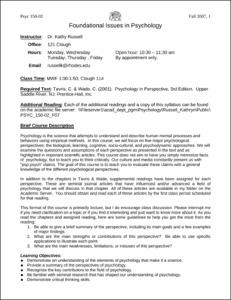 View/Open |
Items in DSpace are protected by copyright, with all rights reserved, unless otherwise indicated.