
Please use this identifier to cite or link to this item:
http://hdl.handle.net/10267/3626| Title: | PSYC 481-01, Senior Seminar on Privilege, Spring 2008 |
| Authors: | Wetzel, Chris |
| Keywords: | Psychology, Department of;Syllabus;Text;Curriculum;2008 Spring |
| Issue Date: | 9-Jan-2008 |
| Publisher: | Memphis, Tenn. : Rhodes College |
| Series/Report no.: | Syllabi CRN 28507 |
| Abstract: | This course is designed to give students the opportunity to integrate skills and understanding critical to the discipline of psychology. Students will complete a major project which will require the application of work they have done in methods and content area courses in psychology. We will work in teams, consistent with the collaborative model that dominates contemporary psychological research. Knowledge Objectives: You will review a body of literature on different types of privilege: gender, sexual orientation, social class, race, age, beauty, and disability. You will become fully conversant with the research and theory that is relevant to your project. The level of expertise that you gain by the completion of your senior papers should prepare you to communicate effectively with professionals in your area of study. Personal Values/Commitment/Application Objectives: It is my hope that this course will open your eyes to the subtle ways in which you may have been privileged as well as disadvantaged. This awareness should impact your views about social and educational policy. It may even impact your sexual, racial, etc. identity. Student Skills Objectives: In this class I hope to exercise and improve a set of skills used by professionals in psychology and in many other related fields. Most notably, these will include: research skills: You will conduct a literature review and write a research report in APA format, and disseminate results to appropriate audiences. collaboration skills: almost all psychological research is done in a collaboration model. You will gain experience working as part of a team and you will gain experience providing and receiving critical peer feedback on all aspects of the work. professional communication skills: You will have opportunities to enhance communication skills in two areas: the ability to make formal presentations to professional audiences and the ability to contribute to conversations (in-class, and in out-of-class informal meetings) that encourage the thoughtful expression of different points of view and that deepen our mutual understanding of the work we are doing. |
| Description: | This syllabus was submitted to the Office of Academic Affairs by the course instructor. |
| URI: | http://hdl.handle.net/10267/3626 |
| Appears in Collections: | Course Syllabi |
Files in This Item:
| File | Description | Size | Format | |
|---|---|---|---|---|
| 2008_sp_PSYC_481-01_28507.pdf | 84.72 kB | Adobe PDF | 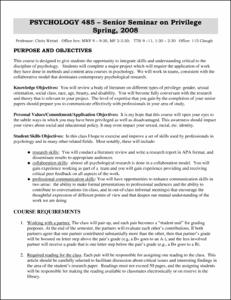 View/Open |
Items in DSpace are protected by copyright, with all rights reserved, unless otherwise indicated.