
Please use this identifier to cite or link to this item:
http://hdl.handle.net/10267/4940| Title: | ENGL 485-02, Senior Seminar: The Return to Philogy, Fall 2009 |
| Authors: | Newstok, Scott L. |
| Keywords: | English, Department of;Syllabus;Curriculum;Academic departments;Text;2009 Fall |
| Issue Date: | 26-Aug-2009 |
| Publisher: | Memphis, Tenn. : Rhodes College |
| Series/Report no.: | Syllabi CRN;10261 |
| Abstract: | A critical investigation of the contested notion of philology, the historical foundation for literary studies today. In the nineteenth century, the term philology came to describe an approach to literature that concentrated on reconstructing the history of languages; its monumental achievement is the Victorian Oxford English Dictionary. For much of the twentieth century, however, such methods were often dismissed as lacking theoretical sophistication. Yet many critics are now arguing for a return to philology as a radical way to re-ground literary studies. This course will survey the fascinating tradition of philological criticism, via figures such as Friedrich Nietzsche, Raymond Williams, Erich Auerbach, Paul de Man, and Edward Said. We will test their insights through selected works of pre-1800 literature, in which authors such as Geoffrey Chaucer, William Tyndale, William Shakespeare, Jonathan Swift, and Samuel Johnson enacted proto-philological meditations (including troubling debates surrounding English translations of the Bible). Independent projects will involve a philological study of a conceptually rich keyword, arguing for its evolution across major Anglophone writers. Although the emphasis of the course will be on medieval and renaissance texts, it may be possible for students to develop final projects that include modern literature. As the capstone seminar in the English department, students will be expected to evaluate scholarly resources a regular basis; write brief but regular critical reflections on primary and secondary reading; and complete a lengthy (20-25-page) final research project that argues for their own interpretation in dialogue with the critical tradition within this field. While the topics for each section of the senior seminar diverge, they all have in common an in-depth analysis of a particular issue or question during the first half of the term, followed by intensive independent research in the second half of the term, culminating in a final essay. |
| Description: | This syllabus was submitted to the Office of Academic Affairs by the course instructor. |
| URI: | http://hdl.handle.net/10267/4940 |
| Appears in Collections: | Course Syllabi |
Files in This Item:
| File | Description | Size | Format | |
|---|---|---|---|---|
| 2009_FALL_ENGL_485_02_10261.pdf | 149.16 kB | Adobe PDF | 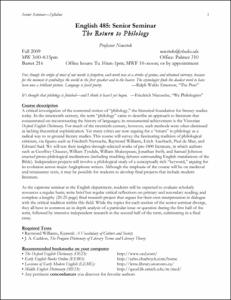 View/Open |
Items in DSpace are protected by copyright, with all rights reserved, unless otherwise indicated.