
Please use this identifier to cite or link to this item:
http://hdl.handle.net/10267/9656| Title: | Transformational Leadership in Sport: Coaching Behaviors, Team Cohesion, and Student-Athlete Commitment |
| Authors: | Parazak, Stephanie E. |
| Keywords: | Text;Psychology, Department of;Honors papers;Student research |
| Issue Date: | May-2011 |
| Publisher: | Memphis, Tenn. : Rhodes College |
| Abstract: | Although transformational leadership has been utilized as a successful leadership model in business, education, and military settings, more research is needed to extend its applicability to sport. Based on survey data collected from 356 National Collegiate Athletic Association student-athletes representing eight different sports, the present study examined the relationship between transformational leadership and student-athlete gender as these variables predict student-athlete ratings of team cohesion and athlete commitment to the sport team. Results indicated that transformational leadership predicted increased team cohesion and that female athletes rated their teams as more cohesive than did male athletes. Further, ratings of coach transformational leadership behaviors significantly and positively predicted student-athlete commitment, but this effect was stronger for male athletes than female athletes. Additional exploratory analyses indicated that the four subscales of the transformational leadership paradigm were strongly correlated; thus the components of transformational leadership are unlikely to have unique effects on team dynamics and are vulnerable to critique due to their lack of discrimnant variability as subscales. These findings suggest that utilizing transformational leadership behaviors may be an effective way for collegiate athletic coaches to increase cohesion and commitment among their student-athletes and raise questions as to the uniqueness of the four dimensions of transformational leadership. |
| Description: | Stephanie Parazak granted permission for the digitization of this paper. It was submitted by CD. |
| URI: | http://hdl.handle.net/10267/9656 |
| Appears in Collections: | Honors Papers |
Files in This Item:
| File | Description | Size | Format | |
|---|---|---|---|---|
| Parazak_Stephanie_Honors_2011.pdf | 530.8 kB | Adobe PDF | 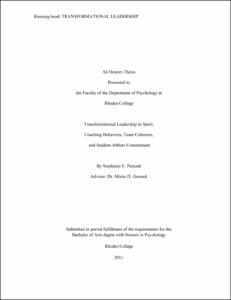 View/Open |
Items in DSpace are protected by copyright, with all rights reserved, unless otherwise indicated.